Saturday, June 1, 2013

Canadians Losing Trust and Support for Stephan Harper's government performance

 
A new Canadian poll shows that only 13 percent of Canadians believe Prime Minister Stephen Harper is honest in saying that he had no knowledge of the recent scandal involving his chief of staff's 90,000-dollar bailout of Senator Mike Duffy.

The poll, conducted by Ipsos Reid on May 27 and 28, involved 1,009 respondents and was published on Thursday by CTV News.

More than 42 percent were “convinced that the prime minister would have known about the monetary gift by Mr. Wright at the time.”

And upwards of 44 percent were “not sure whether or not the prime minister had any knowledge of the monetary gift made by Mr. Wright at the time.”

The survey also showed that the support for Harper’s government has declined as six in 10 Canadians either “strongly” or “somewhat” disapprove of the conservative government’s performance.

While the remaining four in 10 approved of the government’s performance at some level, down four points from last month's reading.

More than two-thirds of those who answered the poll, 69 percent, said it was “time for another federal party to take over,” an increase of 11 percent since a poll conducted in December 2010.

Those who believed that the Harper government “has done a good job and deserves re-election,” were at 31 percent, down from the previous reading of 42 per cent.

Throughout the scandal, Harper insists that he was not aware about the payout to Senator Mike Duffy.

On May 19, Harper's chief of staff Nigel Wright announced his resignation after it was revealed on May 14 that he had secretly given a check of 90,000 Canadian dollars (about USD 87,000) to the senator, who resigned from the conservative caucus on May 16.

Wright
gave the money to help Duffy repay housing expenses, which the senator had improperly claimed.

Thursday, May 30, 2013

Must See & Share: Harper in the Bunker


The Evil that is Monsanto

We're hearing so much about Monsanto these days, the pure, unvarnished truth about this most evil and corrupt of corporations.

GMO genetic pollution alert: Genetically engineered wheat escapes experimental fields planted across 16 states

Thursday, May 30, 2013
by Mike Adams, the Health Ranger
Editor of NaturalNews.com

(NaturalNews) The genetic apocalypse we've been warning about for years may have already begun. The USDA just announced they found a significant amount of genetically engineered wheat growing in farm fields in Oregon. As the USDA announced yesterday, "...test results of plant samples from an Oregon farm indicate the presence of genetically engineered (GE) glyphosate-resistant wheat plants."

Why is this a big deal? Because GE wheat has never been approved for commercialization or sale. These strains of GE wheat escaped from GMO field experiments conducted across 16 states by Monsanto from 1998 to 2005. As the USDA states, "Further testing by USDA laboratories indicates the presence of the same GE glyphosate-resistant wheat variety that Monsanto was authorized to field test in 16 states from 1998 to 2005."

And that means genetic pollution is already out of control. The GE wheat for which Monsanto claims patent ownership is now invading farms that never planted GE wheat.

Read the whole article here. 

******************************
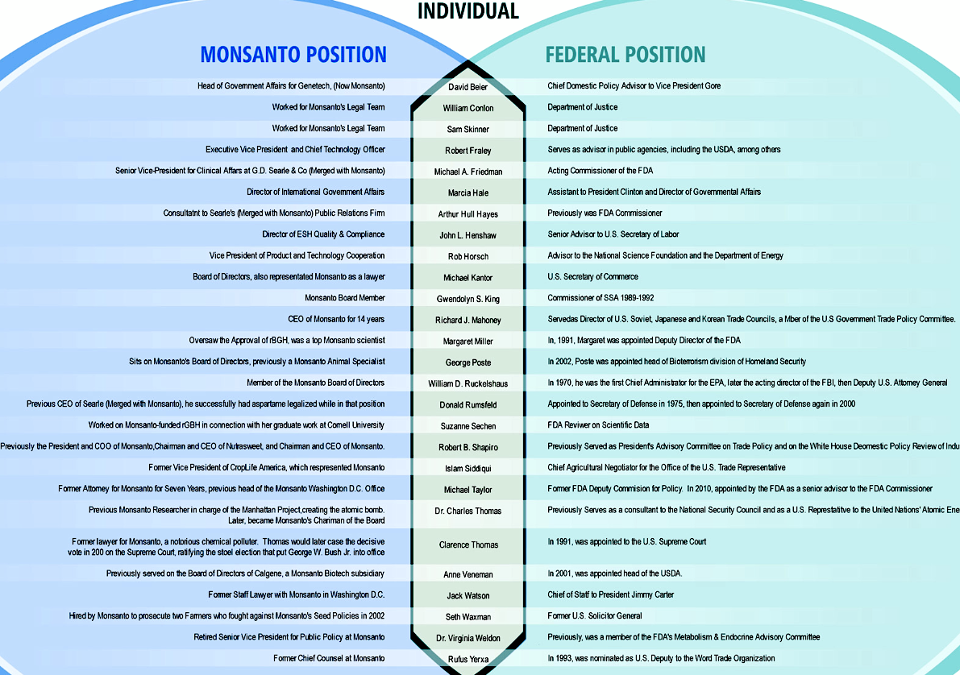
http://gmoawareness.files.wordpress.com/2011/05/monsanto-fda.png

Monsanto’s Dirty Dozen

011.

#1 – Saccharin

#2 – PCBs

#3 – Polystyrene

#4 – Atom bomb and nuclear weapons

#5 – DDT

#6 – Dioxin

#7 – Agent Orange

#8 – Petroleum-Based Fertilizer

#9 – RoundUp

#10 – Aspartame (NutraSweet / Equal)

#11 – Bovine Growth Hormone (rBGH)

#12 – Genetically Modified Crops / GMOs

Read the whole article here.

Thursday, October 25, 2012

What Was Really Going on in BC's Ministry of Health?

Fired staffer fights back in B.C. research scandal: Lawsuit sheds light on government allegations against researchers

Seven workers who were either fired or suspended in a health research scandal now no longer work for the government, but one of them is fighting back.

Dr. Margaret MacDiarmid, B.C.'s health minister, announced in September that the ministry had launched an investigation into the relationship between university researchers seeking grants and some employees in the ministry division that decides what drugs B.C.'s Pharmacare program covers.

At that time three employees had been fired and four had been suspended.

MacDiarmid said Wednesday all the employees are now gone, including one who was suspended and later filed a defamation suit against her ministry.

Once anyone goes forward and says they've been constructively dismissed, then they don't work for the employer anymore," MacDiarmid said.

"None of them any longer work for the ministry."

In September, MacDiarmid said she was "deeply troubled" over the allegations within her ministry, but she said Wednesday she can't give any further details in order to protect the privacy of those involved.

But the ministry filed a statement of defence earlier this month in response to a defamation lawsuit from Malcolm Maclure, who was a director of research and evidence development with the ministry's pharmaceutical services division.

'Preferential treatment' alleged

The statement of claim and the statement of defence contain allegations and claims yet to be proven in court.

The statement of defence denies all of Maclure's allegations and also sheds some light on the issues involved in the scandal.

The statement of defence said that Maclure was suspended for failing to comply with policies and procedures by "giving preferential treatment to his preferred candidate and member of his extended family."

It also alleged Maclure disclosed confidential information and accused him of "facilitating or knowingly failing to prevent the unauthorized access to data by employees and/or third parties."

The statement of defence argued that Maclure ended his employment himself by having his lawyers notify the ministry that Maclure considered his employment to be at an end.

Maclure said in his suit filed Sept. 14 that he enjoyed an "exemplary" reputation as a "world leading authority" in the field of health services epidemiology and had served as a "distinguished scholar" at Harvard's school of public health and at the school of health information science at the University of Victoria.

Claims defamation

"He was at all times during his employment, scrupulous in avoiding conflicts of interest and diligent in preserving and improving data privacy," state the documents.

He said in his suit that he was on holiday with his family in Europe in June when his government email account was shut down and he was sent a letter through his wife's email account informing him he had been suspended.

His suit said his suspension was made known within the Health Ministry and was made worse by media stories about the allegations of inappropriate access to medical information.

Maclure's suit alleged he was identified and the implication was that he was involved in the misuse of health data, was involved in breaches of patient privacy and is guilty of serious employment misconduct.

"The high-handed and callous conduct of the defendant, as set out herein, which has defamed the plaintiff, is ongoing and entitles the plaintiff to punitive and exemplary damages," the suit noted. 

MacDiarmid said Wednesday she isn't sure how long it will take for the investigation.

Wednesday, October 17, 2012

Canadian Government Whistleblowers are ignored, sidelined and silenced


Whistleblowers are ignored, sidelined and silenced

iPolitics Insight

One of Ottawa’s open secrets is on the table again.

The people mandated to help and protect whistleblowers within the federal public service evidently do the opposite.

This conclusion should be drawn from the recent Federal Court decision that underscores how whistleblowers are ignored, sidelined and silenced by the very body whose mandate it is to protect them and to expose wrongdoing.

The Hon. Madam Justice Mactavish ruled in El-Helou v. Courts Administration Service et al. that the Office of the Public Sector Integrity Commissioner (OPSIC) failed in its duty, under the Public Servants Disclosure Protection Act (PSDPA), “…to ensure that the right to procedural fairness and natural justice of all persons involved in investigations is respected, including persons making disclosures…” 

The first PSDA allegation to ever be referred by the Integrity Commissioner to the Public Servants Disclosure Protection Tribunal was “Mr. El-Helou’s allegation of reprisal relating to the withholding of his Top Secret security clearance…”

OPSIC’s investigation was undertaken by three different investigators over a 21 month period. Mr. El‑Helou was assured in writing by investigators:
a) that he would be made aware of the substance of evidence obtained by the investigation and provided an opportunity to respond to findings;
b) that his allegation – that he was threatened with another security check unless he complied with his employer’s “wishes” – was investigated and would be included in the investigator’s report; and
c) that the former Chief Administrator of the Courts Administration Service (CAS), David Power, would be interviewed.

The Office of the Public Sector Integrity Commissioner broke all three promises.

The Hon. Madam Justice Mactavish judged that:
a) not to give Mr. El‑Helou the opportunity to respond to the investigator’s findings “…is a clear breach of the common law duty of procedural fairness”;
b) the investigator’s failure to report her investigation of Mr. El-Helou’s allegation regarding a second security check meant this allegation was never considered by the Commissioner in his decision; and
c) David Power, the former CAS Chief Administrator, was never interviewed.

Her Lordship concluded that Mr. El‑Helou’s legitimate expectation of procedural fairness had been thwarted, and that “the investigator failed to investigate obviously crucial evidence.”

Her Lordship compared the framework of the Public Sector Disclosure Protection Act (PSDPA) to that of the Canadian Human Rights Act (CHRA) and referred to CHRA case law in her judgment, noting that “…the public interest plays a role in each process…”
The public interest is clearly at stake here. The Courts Administration Service serves the Federal Court of Appeal, the Federal Court, the Court Martial Appeal Court of Canada and the Tax Court of Canada. Any report of wrongdoing in this Service is a very serious matter as it could speak to the functioning of our judiciary at the highest levels.

Members of Canadians for Accountability believe that how Mr. El‑Helou was treated is typical. We see a pattern of punishing and trampling the rights of public servants for doing the right thing or for exercising legitimate recourse open to them when they become aware of wrongdoing.

The first Integrity Commissioner, Christiane Ouimet, was appointed by the government of Prime Minister Stephen Harper in 2007 and retired in October 2010 with a severance of approximately $544,000 and a “Departure Agreement” wherein she promised “to keep all information acquired by her or disclosed to her regarding the business of the Public Sector Integrity Commissioner strictly confidential”.

This was after a scathing report by the Auditor General of Canada, Sheila Fraser, signalled serious mismanagement issues, including the fact that all 228 complaints to the Office since its creation had been rejected. Mario Dion, our current Integrity Commissioner, was appointed by the government of Prime Minister Stephen Harper in 2010.

This Office should be about trust. Employees are not going to come forward readily unless they trust the system to work. As this Federal Court decision clearly demonstrates, the current system does not appear to be working.

Allan Cutler is President of Canadians for Accountability; Martin McGreal is a Director of Canadians for Accountability. Canadians for Accountability is a not-for-profit group which aims to promote a culture of truth, transparency and integrity in Canada’s public and private sector institutions and Canadian society in general.
The views, opinions and positions expressed by all iPolitics columnists and contributors are the author’s alone. They do not inherently or expressly reflect the views, opinions and/or positions of iPolitics.
© 2012 iPolitics Inc.

Whistleblower forced investigation of TransCanada pipeline

Engineer Evan Vokes repeatedly raised concerns with company behind Keystone XL pipeline

A former TransCanada engineer says he reported its substandard practices to the federal energy regulator because he believed the company’s management, right up to the chief executive officer, refused to act on his complaints.

In an exclusive television interview with CBC News, Evan Vokes said he raised concerns about the competency of some pipeline inspectors and the company’s lack of compliance with welding regulations set by the National Energy Board (NEB), the federal energy industry regulator.

"I wrote a series of emails to a series of project managers saying, 'We can't do this practice, we can’t do this practice, we can’t do this practice,'" Vokes said. "And I received increasingly pressured emails about how things were OK to do it that way."
Vokes said he refused to back down and the workplace friction eventually took its toll. "It was unbelievable the effect it was having on my health," Vokes told CBC News chief investigative correspondent Diana Swain. "I was certainly on my way to a heart attack, or a stroke, for sure. There is no doubt about it."

Vokes said he met with the Calgary-based company's vice-president of operations, and he also wrote a detailed letter to TransCanada Corp. chief executive officer Russ Girling. Frustrated, he finally made a formal complaint to the NEB, a version of events confirmed in an interview by the board's chief engineer.

"We understand he went right through the chain of command to the top in [TransCanada Pipelines Ltd.]," Iain Colquhoun said in an interview.

"Evan Vokes took the initiative to try and resolve the problem using the internal procedures and we would encourage people to do that,” Colquhoun said. "But having not got there, he took the extra step of involving the regulator, and we would certainly encourage that."

TransCanada reprimanded

Vokes went on stress leave in November 2011. In March 2012, he met with top National Energy Board officials and on May 1, he filed a formal written complaint with the NEB. TransCanada fired him on May 8.

Vokes, 46, had been a machinist and a welder before he returned to the University of Alberta at age 30 to become a metallurgical engineer. Barry Patchett, a retired metallurgy professor, said he knows his former student as an engineer who is technically proficient, honest and responsible.

Patchett said if Vokes made a complaint, "you can take that seriously; take it to the bank, because from what I know, he takes his responsibility, his work seriously."

Last Friday, the NEB issued a public letter to TransCanada. Without naming Vokes, it said "many of the allegations of regulatory non-compliance identified by the complainant were verified by TransCanada’s internal audit."

The NEB said it was “concerned by TransCanada’s non-compliance with NEB regulations, as well as its own internal management systems and procedures.”

Pipeline safety of 'paramount importance'

The regulator warned the company it would not tolerate further infractions of regulations related to welding inspections, the training of pipeline inspectors and internal engineering standards. It also announced a further audit of the company’s inspection and engineering procedures.
'We are confident that any remaining concerns the regulator has about compliance and pipeline safety will be unwarranted.'—TransCanada statement
"Pipeline safety is of paramount importance to the NEB, and it will take all available actions to protect Canadians and the environment," the regulator stated.
The board, however, said the deficiencies "do not represent immediate threats to the safety of people or the environment.”

In an email statement to CBC News, TransCanada said “our reviews concluded that the items raised by the former employee were identified and addressed through routine quality control processes well before any facilities went into service.

"We are confident that any remaining concerns the regulator has about compliance and pipeline safety will be unwarranted," the TransCanada statement said.

The NEB is continuing its investigation of TransCanada and warned that if the company doesn't fix the identified problems, it "will not hesitate to impose appropriate corrective actions."

Lack of independent inspection questioned

Many of the complaints by Vokes focused on TransCanada's practice of allowing its pipeline and fabrication contractors to hire the inspectors that would be inspecting the contractors' work.

In 1999, the NEB imposed a regulation which requires the companies contracting the work, such as TransCanada, to supply independent inspectors to inspect the contractors' work.

"There is an inherent conflict when a prime contractor does his own inspections," Vokes said, especially when the project involves gas pipelines under high pressure because the consequence could be greater since it relates to public safety.

"In pipelining, there is a huge amount of stress for a very thin pipe," he said. "You certainly should be paying attention to what is wrong with your pipe, making sure nothing happens to it, and there are no injurious defects to your pipe as it is being put into the ground."

Vokes said the NEB regulation ensures contractors can’t pressure inspectors to sign off on work that is not up to code.

TransCanada has publicly admitted it did not always follow this regulation in the past, but said it was industry standard. Vokes said TransCanada believed independent inspection slowed production, driving up construction costs.

Keystone XL pipeline a U.S. election issue

These latest revelations about TransCanada's substandard practices come in the midst of a U.S. presidential election campaign in which the proposed Keystone XL pipeline is an issue.

The Keystone XL pipeline project would extend an existing pipeline that carries oil from northern Alberta to refineries in the United States. The Keystone XL pipeline project would extend an existing pipeline that carries oil from northern Alberta to refineries in the United States. (TransCanada Corp.)
 
 A subsidiary of Calgary-based TransCanada Corp. is proposing to build the controversial $12-billion pipeline to transport 830,000 barrels a day of mostly Alberta oilsands crude to refineries on the U.S. Gulf Coast.
U.S. President Barack Obama rejected the application by TransCanada in November 2011, saying more time was required to assess its environmental risks.

The firm resubmitted its proposal for an altered northern segment of the route in May. It said the proposal addressed concerns about potential damage to a massive aquifer beneath the environmentally sensitive Nebraska Sandhills. The pipeline, however, is also facing strong public opposition in Texas from landowners and others.

The New York Times published a letter to the editor in May from TransCanada Corp. CEO Russ Girling in support of its Keystone XL application. In it, Girling said TransCanada had “safely and reliably operated pipelines and other energy infrastructure across North America for more than 60 years."

"Our existing 2,154-mile Keystone pipeline from Alberta to Cushing, Okla., has delivered 240 million barrels of Canadian oil safely to American markets since 2010," Girling wrote.
TransCanada Corp. is one of North America's biggest pipeline companies, with approximately 57,000 kilometres of natural gas pipelines, plus storage facilities and power plants in Canada and the U.S.

If you have more information on this story, or other investigative tips, please email investigations@cbc.ca.

Monday, October 10, 2011

The Sounds of a Global Meltdown: Who really rules the World

"The governments don't rule the world, Goldman Sachs rules the world... The first thing people should do is protect their assets, protect what they have ... my prediction is that the savings of millions of people is going to vanish and this is just the beginning."

The sound of global markets and domestic realities imploding. Useless efforts to plug the holes in the dam. An elite more powerful than we can possibly imagine, impoverishing the human race right under our very noses.

Watch the video that's gone viral: Alessio Rastani, unabashedly telling the world how to make money from the impending crash.

'Anyone can make money from a crash,' says market trader

Ministers from the world's richest nations are reportedly on the way to agreeing a deal for troubled eurozone countries.

Following the IMF meeting in Washington, the BBC understands that three elements have been discussed.

They include a so-called "haircut" of Greece's sovereign debt, meaning institutions holding Greek debt would have to write off half of what they were owed.

The plan also envisages an increase in the size of the European Union bailout fund to two trillion euros.

European governments hope to have the plan in place in five to six weeks.

But one independent market trader - Alessio Rastani - told the BBC the plan "won't work" and that people should be trying to make money from a market crash.

*********************

IMF Advisor: Global Financial Meltdown in 2 to 3 Weeks
Zero Hedge, October 6, 2011.

Watch the video of Sir Mervyn King speaking about the decision by the Bank’s Monetary Policy Committee to put £75billion of newly created money into the economy in a desperate effort to stave off a new credit crisis and a UK recession.

World facing worst financial crisis in history, Bank of England Governor says
The world is facing the worst financial crisis since at least the 1930s “if not ever”, the Governor of the Bank of England said last night.

Dexia bank gets massive bailout

France, Belgium and Luxembourg are to bail out the troubled bank Dexia, following fears it could go bankrupt.
BBC News, October 10, 2011.

Austria, Hungary:


Erste Group Reveals Stunner: Reports Billions In Previously Undisclosed
Underwater Sovereign CDS; Who Is Next? And How Much More Is Out There?
Zerohedge.com

Debt crisis: live
, Martin Strydom, 10 Oct 2011, The Telegraph

Markets edge up on Merkel and Sarkozy plan to pump money into banks but default fears linger as EU prepares to delay forthcoming summits due to ongoing talks on steeper losses for Greek bondholders.

Friday, October 7, 2011

#OccupyWallStreet: A Global Whistleblow & Line in the Sand

Check, check, how's it sound?

My apologies for not writing for such a long time, life is very busy. Much whistleblowing and the usual obstruction and corruption continues only the stakes are much higher now. Our "global village" is in unparalleled peril on many fronts.

But, as in other ages, the people are rising up all over the world. Those who are bruised, bloodied and burdened by a kind of slavery in the modern world. Too many are hurting, so revolution and protest is in the air.

Here are some links with some inklings of what is going on in North America, the growing #OCCUPYWALLSTREET movement that is going far beyond the belly of the beast.

Adbusters' Kalle Lasn Talks About OccupyWallStreet


The Tyee, October 7, 2011.


The veteran culture-jammer on his role in getting the protest rolling, magic memes, what he would demand, and more.

"We always thought of ourselves as the catalyzers, the people who set that meme, as we like to call it, in motion. And right from the start we decided that we're not going to play a part on the street, that if our meme flies, if people love it, then we're happy to come up with posters, and we did send them all kinds of handbills and we sent them corporate America flags.

************************

#OccupyWall Street: The Most Important Thing in the World Now

We pointed out that the deregulation behind the frenzy came at a price. It was damaging to labor standards. It was damaging to environmental standards. Corporations were becoming more powerful than governments and that was damaging to our democracies. But to be honest with you, while the good times rolled, taking on an economic system based on greed was a tough sell, at least in rich countries.

Ten years later, it seems as if there aren’t any more rich countries. Just a whole lot of rich people. People who got rich looting the public wealth and exhausting natural resources around the world.

The point is, today everyone can see that the system is deeply unjust and careening out of control. Unfettered greed has trashed the global economy. And it is trashing the natural world as well. We are overfishing our oceans, polluting our water with fracking and deepwater drilling, turning to the dirtiest forms of energy on the planet, like the Alberta tar sands. And the atmosphere cannot absorb the amount of carbon we are putting into it, creating dangerous warming. The new normal is serial disasters: economic and ecological.

Monday, October 25, 2010

Big Money, For Little Protection: Blowing the Whistle on a Sham Tribunal

Little Known, Little Used Whistleblower Panel Budgets $8.1 million
Amy Minsky, October 25, 2010. Postmedia News.

OTTAWA — A little-known, never-used government tribunal will spend as much as $8.1 million of taxpayers' money by the end of 2012-13, federal documents show.

The Public Servants Disclosure Protection Tribunal was set up in 2007 to protect public servants from retaliation after reporting immoral or illegal activities in government. Since then, it hasn't heard a single case.

The fact that the tribunal hasn't been used comes to light following the sudden departure on Oct. 18 of Christiane Ouimet, the first federal public sector integrity commissioner, while her office was being investigated by Auditor General Sheila Fraser.

The tribunal would take cases referred by the Ouimet's office. In three years, the commissioner didn't find any wrongdoing in any of the 170 complaints her office received.

Fifty-eight whistleblowers complained to the commissioner's office since 2007-2008, saying they were mistreated or violated after filing a report. The commissioner launched only four investigations as a consequence of those complaints, and only two have been completed.

Because neither had findings of reprisal, the tribunal has never been referred a case.

"It's clearly a waste of money," said David Hutton, executive director with the Federal Accountability Initiative for Reform (FAIR), a registered charity advocating for whistleblower protection. "This whole expensive system has achieved absolutely nothing. In fact, it has made things worse."

Hutton said to the integrity com the tribunal gives whistleblowers an "illusion of protection" when the reality is civil servants are left without recourse after filing a complaintmissioner about irresponsible, immoral or illegal government activities.

The tribunal spent $836,000 in 2008-09, according to its performance report from that year, and has tabled spending estimates of $1.83 million for each successive year until 2012-13.

Lisanne Lacroix, the registrar and deputy head of the tribunal's office, said she is surprised they haven't received a single case in three years. But, as she pointed out, the lack of work has meant less money actually spent.

"I have $1.828 million in my budget," she said. "But since we haven't had any cases, I haven't spent it."

Money not used is returned to the government each year.

While waiting for a case, the office has established rules and guidelines, trained staff and become familiar with legislation, Lacroix said.

She said the office currently employs four full-time and two part-time employees.

But if and when the tribunal eventually hears a case, there is virtually no chance the public servant will win, Hutton argues.

An equivalent "kangaroo court" in the United States heard 2,000 complaints, and only four cases prevailed, Hutton said. "It's virtually impossible for an employee to prove that an employer took reprisal against them. It's very hard to look at this system and come to any conclusion other than this is for show."

Prime Minister Stephen Harper created an independent Public Sector Integrity Commissioner to protect whistleblowers in 2007, with the intention of making civil servants feel protected when calling government on a misdoing.

But some opposition MPs say it's clear the legislation isn't working.

"I think you can safely say the Conservatives broken promises are expensive," NDP MP Pat Martin said. "It's a smoke-and-mirror illusion of whistleblower protection, when really, the legislation is inadequate to really protect them in any case."

Thursday, October 21, 2010

Editorial: Effective Whistleblowing Protection Needed

What the public knows about the Basi/Virk case is the tip of the iceberg. And the people who know the most have been protected and indemnified. It pays so well to be in politics, for some.

BC Needs Effective Legislation to Protect Whistleblowers
Editor, Burnaby Now, Oct. 21, 2010

In the week following the dramatic rescue of 33 trapped workers from a Chilean mine, Chile’s president was pressured to ratify an international convention protecting whistleblowers who bring to light safety concerns at work.

The need to protect whistleblowers sounds like a problem from the developing world.

Surely Canadians have this all worked out. Or have we?

The recent Basi-Virk case, in which the duo pled guilty to breach of trust and accepting benefits relating to the sale of BC Rail, doesn’t just raise questions about the honest dealings of public employees involved in big-money projects.

It also questions the safeguards in place to protect those who may be aware of wrongdoing, but fear the repercussions of going public.

In British Columbia, the NDP introduced Whistleblower legislation in 2007 but it died on the vine. At the federal level, however, the Public Servants Disclosure Protection Act was enacted the same year, and is supposed to protect federal civil servants from the repercussions of whistleblowing.

That said, according to a report from the Public Sector Integrity Commissioner, the sentiment amongst civil servants is that the law doesn’t do enough to protect people who bring questionable conduct to light.

This sentiment is echoed by the Federal Accountability Initiative for Reform, FAIR.

One FAIR statement rings especially true in light of recent events in B.C.:

“Virtually every scandal—in government or in the public sector—has a whistleblower dimension: either because the story has come to light through information provided by insiders, and/or because the problem was preventable if the organization had listened to these insiders and fixed the problem, instead of covering up.”

One can’t help but wonder if effective whistleblower legislation in B.C. could have prevented the Basi-Virk affair in the first place.

Friday, September 24, 2010

The Price of Saying No: Unravelling Democracy in BC

One strand at a time, this is what it looks like when democracy is being unravelled. Well, perhaps it's more visceral than that. This is what it looks like when a corrupt government and it's leaders rip apart an already bruised and battered Democracy.

This is what happens to those who stand up and say no. Stand up for the citizens of BC. There is no more room for that in BC.

In April 2010, Linda Johnston, deputy chief electoral officer with Elections BC said the provincial government could not fight former premier Bill Vander Zalm's anti-HST petition with a taxpayer-funded mail-out.

Elections BC wrote the government Wednesday saying the government mail out does not meet the rules of the Recall and Initiative Act when it comes to government advertising surrounding promoting or opposing Bills or petitions.

"In order to ensure compliance with the Recall and Initiative Act, it is imperative that government advertising does not indirectly promote or oppose an initiative petition or the associated draft bill in any way unless government first registers as an initiative advertising sponsor and complies with the $5,000 advertising limit," said the letter to the Ministry of Attorney General from deputy chief electoral officer Linda Johnson.

More here.

On June 5, 2010 Chief Electoral Officer Harry Neufeld's term came to an end. Neufeld told the media he had no concerns having to leave before the HST recall petition process has come to an end.

"I have excellent staff here and an extremely capable deputy [Linda Johnston]" he said.

**********************************

Ax Fall on Officer who Nixed Lib's HST Budget Mailer

Linda Johnson's job eliminated by politically appointed interim Elections BC chief.

By Andrew MacLeod, 10 Sep 2010, TheTyee.ca

In September 2010 the Tyee reported that [Craig]James, who was appointed by the government in June on an interim basis until an all-party legislative committee can decide on a permanent chief electoral officer, announced a restructuring that eliminated the deputy chief electoral officer position.

Linda Johnson, who had held the position for 19 years and who had been with the agency that oversees provincial elections for 28 years, lost her job as part of the restructuring.

Interim Chief Electoral Officer Craig James: What is he up to?
Ian Reid, the Real Story, Sept. 24, 2010

Two weeks ago, James fired the deputy Chief Electoral Officer Linda Johnston, claiming he was reorganizing the non-partisan office to be more efficient.

Critics speculated the real reason for the firing had to do with Ms. Johnson’s ruling preventing the government from advertising against the anti-hst campaign. To critics, the firing looked suspiciously like government ordered payback. That only added to concerns that James, the interim Chief Electoral Officer appointed by the government without consultation, was bringing a partisan flavour to the office during an unprecedented period.

Sunday, July 25, 2010

Gambling with more than Dollars: How Organized Crime has Increased their Market Share in BC

In the media business , one would say this story has legs. And arms. And some heads that got together to create a plan for BC to become Super Friendly and pave the way to make it as easy as going online and washing lots and lots of cash 'til it is shiny clean here in Beautiful BC.

Questions to ask. Who made the decisions? Anyone influence the decision-makers? How exactly? Who benefits? Where is the RCMP in all of this? A simple time line tells the story and gives answers to many of the questions that arise out of this latest story of corruption in BC.

Remind us again why it is that BC's gambling and gaming enterprises are under the Ministry of Housing & Social Development and not the Ministry of Public Safety & Solicitor General? Who made that decision when they were deciding on the structure of government?

*************************************************

Fun with FINTRAC
Public Eye Online. July 21, 2010.

Watch Coleman explain it all away here.

Let's compare and contrast: yesterday, when asked about British Columbia Lottery Corp. being fined more than $670,000 for 1,020 violations of the Proceeds of Crime and Terrorist Act, Solicitor General Mike de Jong told The Vancouver Sun, "Obviously the facilities are there to administer to members of the public engaged in lawful gaming activities and if some of these early reports are true, yes, it is troubling." But, last year, when confronted with allegations there was a "ton of criminal activity" at the province's casinos that wasn't being effectively targeted, the minister responsible Rich Coleman gave us a number of reasons why that wasn't the case.

The Financial Transactions and Reports Analysis Centre of Canada is the same agency that fined the lottery corporation.

BCLC president and chief executive officer Michael Graydon has said those fines were connected to problems with the reports it filed to the centre - not money laundering or terrorism.

The Vancouver Sun paraphrased Mr. Graydon as stating those reports - which record transactions of $10,000 or more - were late, had clerical errors or didn't include enough information to satisfy the Act. [Ed. Technical incompetence can excuse away so many things, can't it?]

Mr. Coleman didn't respond to repeated interview requests placed through the housing and social development ministry's communications shop.

The fines, which are being appealed, followed an audit the centre conducted between October 28 and November 19, 2009. Mr. Graydon has said the problems that led to the fines have since been solved.

******************************
Mike DeJong Worried About BCLC's Casinos After Money Laundering Rule Violations: Online Gambling Site also a Concern
Kim Bolan and Jonathan Fowlie, Vancouver Sun July 20, 2010

Solicitor General Mike de Jong says he is concerned about the potential for organized crime to misuse B.C. casinos and online gaming after revelations that the B.C. Lotteries Corp. has been fined $670,000 by the federal agency that tracks money laundering and terrorist financing.

De Jong said Tuesday he is reviewing reports he has just received about more than 1,000 violations by the lottery corporation of the federal Proceeds of Crime and Terrorist Financing Act.

He [B.C. Lottery Corp. CEO Michael Graydon] said the final eight improper reports came because people cashed out more than $10,000 without proper identification, and the casino did not do the follow-up required under the law.

Part of the fine came because B.C. Lotteries missed a deadline for creating "a geographic profiling and high-risk profiling and analysis system" that had been requested by FINTRAC and is now in place, he said.

"In 2008, the BCLC was criticized for inadequate reporting relatd to money laundering," Simpson said. [Shane Simpson, NDP MLA.]

And he said BCLC board chairman John McLernon claimed at the time in a letter then minister John van Dongen that a number of steps were being taken to fix the problem.

McLernon said there were more incidents of suspicious transactions at B.C. casinos than in other Canadian jurisdictions.

Last year, the B.C. government increased the weekly limit that can be spent on online gaming to $9,999 from $120. Critics said the move was set subvert FINTRAC rules where transactions of $10,000 or more must be reported to Ottawa.

De Jong said Tuesday he didn't know how the limit was arrived at.

She [FINTRAC director Jeanne Flemming] said one review indicated half the casinos examined "did not have an effective anti-money laundering training program in place."

***********************************************

Begg's the Question
Public Eye Online. November 16, 2009.

Housing and Social Development Minister Rich Coleman has said the province's anti-illegal gaming team was disbanded on the advice of the RCMP unit's consultative board. But, according to internal documents obtained by Public Eye, the top bureaucrat responsible for overseeing policing in British Columbia wrote about shutting down that government-funded unit "ASAP" three months before the board made its recommendation.

On October 23, 2008, the then director of the province's police services Kevin Begg sent an email to the general manager of the government's gaming police and enforcement branch Derek Sturko with the subject heading "IGET (sic)" - the acronym for the province's now disbanded integrated illegal gaming enforcement team.

In that email Mr. Begg stated, "I need to give RCMP directions to shut the unit down ASAP so that we do not have any financial obligations beyond Mar 31. Not sure how this impacts your unit."

**********************************
Ex-unit Commander questions Government's Commitment to "meaningful" Illegal Gaming Investigations
Public Eye Online. October 21, 2009.

The former commander of British Columbia's now-defunct integrated illegal gaming enforcement team is questioning the provincial government's commitment to "meaningful" illegal gaming investigations. Speaking exclusively with Public Eye, Fred Pinnock also described the RCMP's senior management in British Columbia as demonstrating "willful blindness" when it comes to the connection between illegal gaming and organized crime. And he said his provincially-funded RCMP team should have been expanded - not shutdown.

Mr. Pinnock said there hasn't been any big busts at casinos even though "it obvious that highly-pedigreed gangsters frequent these venues on a continuing basis. There's a ton of criminal activity being conducted in these places every day, including money laundering, loansharking and other enterprise crimes."

The RCMP is "playing ostrich" about the problems inside legal gaming facilities, he concluded, with senior management only giving "token attention" to the illegal gaming problems outside those establishments.

****************************
Question: What were Rich Coleman and Patrick Kinsella Discussing at Dinner Last Night?
Alex G. Tsakumis: Rebel with a Clause.

In what must be one of the STUPIDEST moves for a sitting Cabinet Minister of the Campbell govt, Minister Rich Coleman was having dinner last night at the Keg Restaurant in South Surrey, with none other than former unregistered (non?)lobbyist and BC Liberal insider/pal of the Premier, Patrick Kinsella. They were accompanied by their wives and third woman.

Whistleblowers BC
says:
Your comment is awaiting moderation.

My bet, haha, was it was a social dinner. They would keep the business behind closed doors and away from the wives and any prying eyes. It just doesn’t make sense to be discussing strategy etc. with the wives along at the Keg, they don’t want to hear that crap. Don’t underestimate the power of networking and socializing to cement working relationships.

Coleman doesn’t have a snowballs chance of hell in becoming the next premier. He may duke it out to become the next leader of the party and could win, but this would be the death knell for a party that is already on it’s knees. Don’t forget the former cop, turned politician has bungled every single portfolio he’s been on and there is enough of a trail to seriously question his morals and ethics, which citizens in BC are doing with the party in a big way. His nonchalance over this lottery scandal is indicative of someone who has zero ability to now connect to how voters are perceiving this very serious situation.

Question, where is the commercial crime unit of the RCMP in this lottery scam? You effectively have a sitting government, working in conjunction (colluding?, secret commissions?) with many other players, that has paved the way to what may be the biggest money laundering scheme in Canadian history. The FINTRAC investigation of BC Lottery should be made public and turned over to the RCMP. You just know there was a conversation had between some major players, “hey, you know how we can beat these FINTRAC regulations for reporting, let’s just change the reporting threshold to $9999. That’ll keep FINTRAC out of our hair. Changes like that don’t just happen. What specific individuals were involved in that conversation and then made it happen? The public deserves to know that.

Have said it before, will say it again, the BC Liberal government is the most corrupt, most incompetent and most unethical in the history of this fair province and quite likely Canada.

Sunday, June 27, 2010

Attacks on Democracy: This is NOT my Canada

Full video of police charging on protesters as they finished singing the nation anthem

Yee-Guan's Posterous, June 27, 2010.

********************
Activists Decry Arrests at Peaceful March
Strong show of force disperses group calling on authorities to let arrested protesters go
Tim Kiladze and Adrian Morrow, Globe & Mail.

Sunday, December 13, 2009

Targeting & Retaliation Against Whistleblowers: Why Doesn`t Anyone Want the Truth

While this is an American story, about issues within the U.S. - targeting of whistleblowers, or ethical resisters, it is very common place across nations. As societies we should be asking ourselves how it has come to pass that the people who display high moral decision-making, taking personal and professional risks to come forward in the interests of the public has come to be seen as a thing for which people should be stomped on, targeted and retaliated against. Where has our moral compass gone. Why is that the bad guys (the corrupt, criminals and the morally bankrupt) are protected and shielded from accountability and responsibility for the harm they cause.

Web of FBI, DOJ Criminal Racket Targeting Individual Whistleblowers Hits the Skies

December 13 2009.

Punitive actions against these honest public servants send chilling signals to other would-be whistleblowers… - Captain Dan Hanley

Self-identified targeted individuals’ claims of persecution and widespread, systemic Federal Bureau of Investigation (FBI) and Department of Justice (DOJ) abuse of power are mounting with the grassroots organization, Medical Whistleblowers that includes its Transportation Whistleblower spokesperson, also spokesperson of the Whistleblowing Airline Employees Association, Captain Dan Hanley.

Last week, Hanley stated that the Department of Homeland Security and Transportation Safety Authority were recently responsible for the greatest national and airline passenger security risks since 911 and he continues to highlight FBI and DOJ refusal to respond to former alleged criminal complaints involving United Airlines.

Criminal retaliation against TI whistleblowers

In COINTELPRO signature style of yesteryear, the FBI and DOJ grants immunity to criminals retaliating against citizens that attempt to expose corruption, such as “kidnapping of children, false incarceration after framed by criminal elements in civil and criminal authorities, impoverishment, coercion under duress, and serious physical injury up to and including death.” (Barbara Hollingsworth, UPDATE: FBI, DOJ refuse to investigate charges of judicial corruption, Examiner, 12/03/09)

Self-identified targeted individuals (TIs), many of whom are human rights defenders and corruption whistleblowers, many struggling to survive the above-named retaliatory criminal assaults and persecution, consistently report that the FBI refuses to investigate, the DOJ prevents legal support, and the mental health system denies advocacy.

Instead, TIs are re-victimized, often through forced medical and psychiatric evaluations, sometimes forced psychiatric treatment.

Senator Leahy called to action

Medical Whistleblower Executive Director Dr. Janet Parker has written to Senate Judiciary Chairman Patrick Leahy about issues relating to reporting “Medical Fraud, Abuse and Neglect of Patients and Human Rights Violations” and the possibility of testifying before congressional committees.

Recently, American self-identified Targeted Individuals also wrote to Leahy calling for an investigation:

We, the undersigned, are therefore compelled to request that congressional hearings be held to examine our issues and hear our accounts of what is happening covertly in this country. It is time to end the cover-up and restore our country once again to its founding constitutional principles of freedom of justice for all.

Non-government groups across the nation are calling to impeach DOJ judge Jay Bybee for alleged war crimes resulting in thousands of innocent people being tortured, the latest protest against the 'Torture Judge' at court being last Thursday in Pasadena, California with Sharon Tipton saying, Bybee should be in jail, not sitting on the bench. (See Dupré, We will not be silent. Dupré inerviews Torture Judge Bybee protester Sharon Tipton, December 11, 2009)

Now, commercial aviation safety and security personnel terminated since 2001 for reporting security systems frailties, plus national and international whistleblower advocates want persecuted airline whistleblowers’ cases publicly reviewed.

These airline captains, federal air marshals and others attempting to protect passengers report that the FBI and DOJ refuse to investigate their claims, a national and passenger security grave risk.

Barbara Hollingworth of The Examiner reported that for three years, the FBI and DOJ have refused to investigate material evidence of a nationwide criminal racket allegedly infiltrated in state and federal courts, manipulating and exploiting litigants in bankruptcy, family and probate courts.

Fraud, computer hacking and money laundering

A 2006 affidavit claims that “multiple judges and lawyers are aware of and/or involved in alleged criminal acts,” naming Judge Eugene R. Wedoff, chief Northern District of Illinois bankruptcy judge in 1986.

Wedoff presided over the 2005 United Airlines (UA) bankruptcy resulting in 20 large unsecured creditors losing nearly $18 million and UA defaulting on $3.2 billion worth of pension obligations for over 134,000 employees, “the largest pension default in three decades – while its top executives walked off with millions in exit bonuses,” reported Hollingworth.

Dan Hanley, Whistleblowing Airline Employees Association (www.airline-whistleblowers.org) public spokesperson and former United 777 captain forced out of his job after reporting safety issues impacting passengers, stated that the recent TSA security leak was the greatest threat to passenger security since 911.

Hanley also alleges that United management fraudulently withheld information from the Pension Benefit Guarantee Corporation (PBGC) that took over their pensions, and that PBGC never conducted federally mandated analysis of the United pension fund before agreeing to its termination. Although the Securities and Exchange Commission recently agreed to look into the matter, it has not met its stated deadlines.

Hollingworth reports that a court affadavits allege United Airline associated illegal actions:

  • Judge Wedoff and other alleged criminal judges of accepting $40 million in bribes at LaSalle National Bank in Chicago plus Wells Fargo and Northern Trust Bank in Arizona according to Hollingworth.
  • Wedoff’s payoffs went into ERW Living Trust that purchased Lot 114 of Greenfield Place in Maricopa County, Arizona and the signature of ERW trustee, “Richard E. Williams” is identical to Judge Wedoff’s.
  • A Phoenix, Arizona based criminal racketeering enterprise created fraudulent documents and identity theft to hack into the INSLAW court software program to funnel stolen private and government funds into Omega and Anchor Pure Trusts.
  • These trusts dispersed the hot cash into personal trusts, such as ERW, that then used fake property mortgages already bought with cash to further launder the money.
  • Multiple lawyers of prominent law firms” used fake federal marshal credentials to access the Federal Court Building in Chicago."
  • Wedoff allowed a bankruptcy trustee to confiscate and destroy records and transfer 'large sums of money' to his account at La Salle, 'highly irregular and illegal.'

The FBI and DOJ have not investigated what appears to be a massive criminal infiltration of the federal court system. As Hollingworth posits, “The big unanswered question is: Why not?”

National security and air safety at risk

The Department of Transportation never responded to Hanley’s April 2006 letter to Secretary Mineta. Furthermore, the US Department of Transportation wrote to Hanley stating that his FAA Whistleblower Report, (filed via certified mail with FAA), was “lost” and, “We anticipate no further action from our office regarding this matter.”

In a December 12 letter to Inspector General, Department of Transportation Calvin L. Scovel, Inspector General, Department of Homeland Security Richard L. Skinner, and Inspector General, Department of Justice Glenn A. Fine, Hanley stated:

“The issues addressed in my original and subsequent FAA Whistleblower Reports concerned grave commercial aviation safety and security issues.

“Additionally, allegations of methods of suppression of honest pilots who speak out in the name of passenger safety, but are ushered off the property at their airline through employment of ‘hostile workplace environment forced medical and psychiatric evaluations’ were addressed, as this sometimes results in the pilot loss of his medical certification, a federal requirement to fly commercial jet aircraft.

“Without appropriate governmental oversight of departments responsible for ensuring passenger and aircrew safety, but even more importantly, insurance of enforcement of current whistleblower laws, which sometimes results in retaliatory action against whistleblowers, our national air safety and security is compromised.

Persecution of honest public servants sends "chilling signals to other would-be whistleblowers within the airline industry, the Federal Aviation Administration, and the Federal Air Marshal program" says Hanley.

Ban Ki-moon has pledged to "fight discrimination targeting individuals vulnerable to attack," the 2009 International Human Rights theme being to end discrimination. Whistleblowers are among those most vulnerable to persecution, including assassination.

“With a 2% probability of success for today’s federal whistleblowers under existing laws, stronger language of HR 1507 must be included in the final passage of the ‘Whistleblower Protection Enhancement Act of 2009,’” stated Hanley.

Learn more by taking responsible action and continuing to ask, "Why?" and "Why not?" Your subscribing to Deborah Dupré's reports and posting the link to this site (rather than entire article) are requested and appreciated unless republishing permission is granted.

Email info@DeborahDupre.com. Dupré is author of
Operation H1N1: Vaccine Liberty or Death ebook available at DeborahDupre.com.